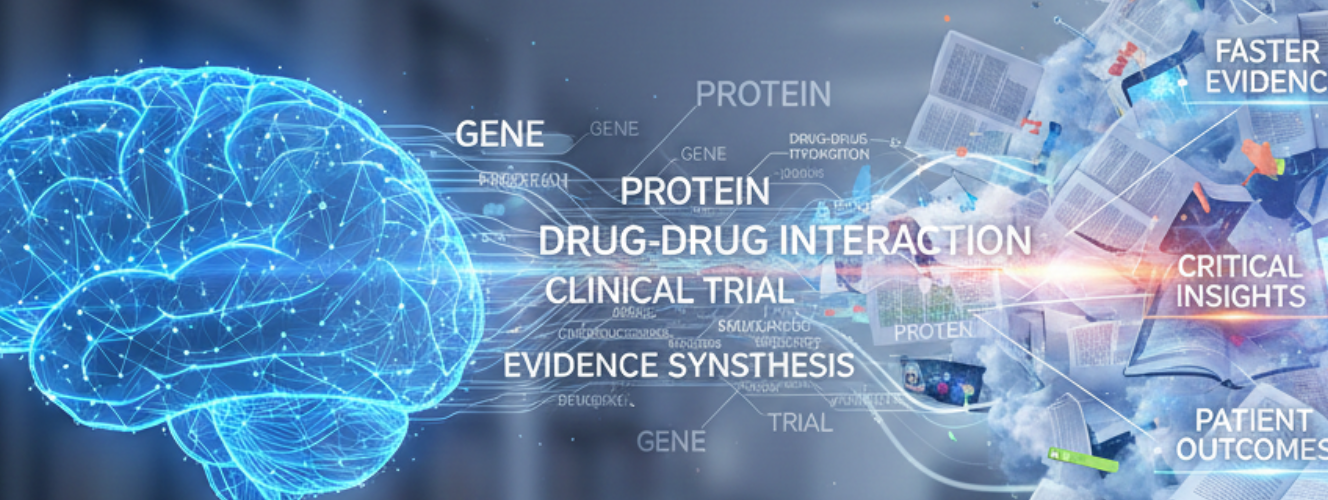
The Speed of Science: How NLP is Revolutionizing Medical Literature
In the world of medicine, information is the most valuable currency. However, we are currently facing a "wealth paradox": there is so much new data being generated that the humans who need it most—doctors, researchers, and policymakers—can no longer keep up.
This is where Natural Language Processing (NLP) steps in. By applying advanced AI to biomedical literature, we aren't just "searching" for papers; we are enabling faster evidence synthesis and unlocking critical insights that were previously buried in a mountain of unstructured text.
The Problem: The "Evidence Gap"
Traditional systematic reviews—the gold standard for medical evidence—are notoriously slow. It can take a team of experts over a year to manually screen thousands of abstracts and extract data for a single review. By the time the results are published, the evidence is often already outdated.
The Solution: NLP as a Research Catalyst
Modern NLP models, specifically those trained on scientific corpora (like BioBERT or ClinicalBERT), act as high-speed digital librarians. They don't just recognize words; they understand medical context.
Automated Screening: NLP algorithms can screen thousands of research abstracts in seconds, identifying relevant studies with up to 90% accuracy, allowing researchers to skip the "noise" and go straight to the "signal."
Named Entity Recognition (NER): These models can automatically flag specific genes, proteins, drug-drug interactions, and adverse effects across millions of pages.
Relationship Extraction: Beyond identifying terms, NLP maps the connections—for example, linking a specific dosage of a drug to a precise patient outcome across multiple disparate trials.
From Data to "Living" Evidence
The most exciting shift in 2026 is the move toward "Living Systematic Reviews." Because NLP can process new papers the moment they are uploaded to databases like PubMed or arXiv, evidence synthesis is no longer a one-time event. It is a continuous, real-time stream.
"We are moving from a world where we look for answers every few years to a world where the answer evolves as the data does."
The Human-in-the-Loop
It's important to note that NLP isn't replacing the scientist. Instead, it's a "force multiplier." By handling the tedious data extraction and organization, AI frees up human experts to do what they do best: interpret the findings, assess the quality of the evidence, and apply it to real-world patient care.
Key Takeaway
By bridging the gap between "big data" and "actionable insight," NLP is ensuring that the latest breakthrough in a lab today can become a life-saving treatment at the bedside tomorrow—not years from now.